⚖️
Fat, not muscle
In the landmark crossover trial, dieters sleeping 5.5 h lost 55% less fat and 60% more lean mass than the same people sleeping 8.5 h on identical calories.
Same diet, 5.5 h vs 8.5 h of sleep: 55% less fat lost. SleepShred tracks how you sleep, finds out why, screens for the sleep disorders most people never get diagnosed with — and shows you the paper behind every claim.
Free · No account · Your data stays on your iPhone
Losing fat is a calorie deficit — categorically simple, practically hard. What most plans ignore is that sleep decides whether the deficit comes out of fat or muscle, and how hungry you'll be while you do it. Every number below links to the study.
In the landmark crossover trial, dieters sleeping 5.5 h lost 55% less fat and 60% more lean mass than the same people sleeping 8.5 h on identical calories.
Two nights of short sleep raise ghrelin, lower leptin and increase appetite ~24%, especially for calorie-dense carbs. Sleep-restricted adults gain ~1 kg in five days, mostly from late-night eating.
Four nights of 4.5 h sleep made fat cells ~30% less insulin-sensitive; five nights of 4 h cut muscle protein synthesis ~18%.
Extending sleep by ~1.2 h in a real-life RCT reduced intake by ~270 kcal/day with no dietary instruction at all.
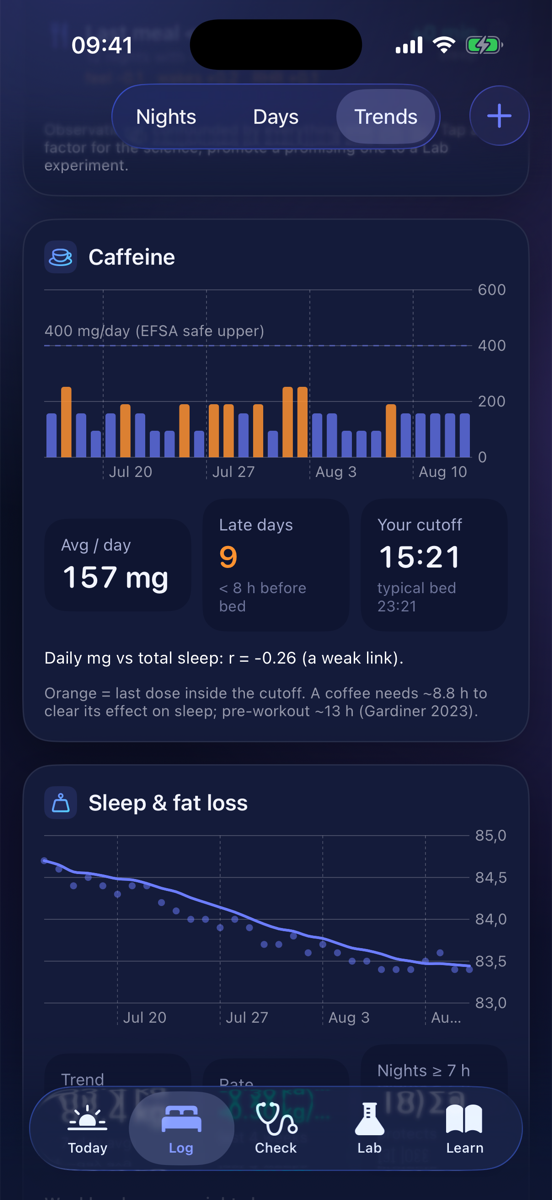
400 mg six hours before bed still cost more than an hour of sleep — while subjects didn't notice. A coffee needs ~8.8 h to clear its effect. SleepShred computes your personal cutoff.
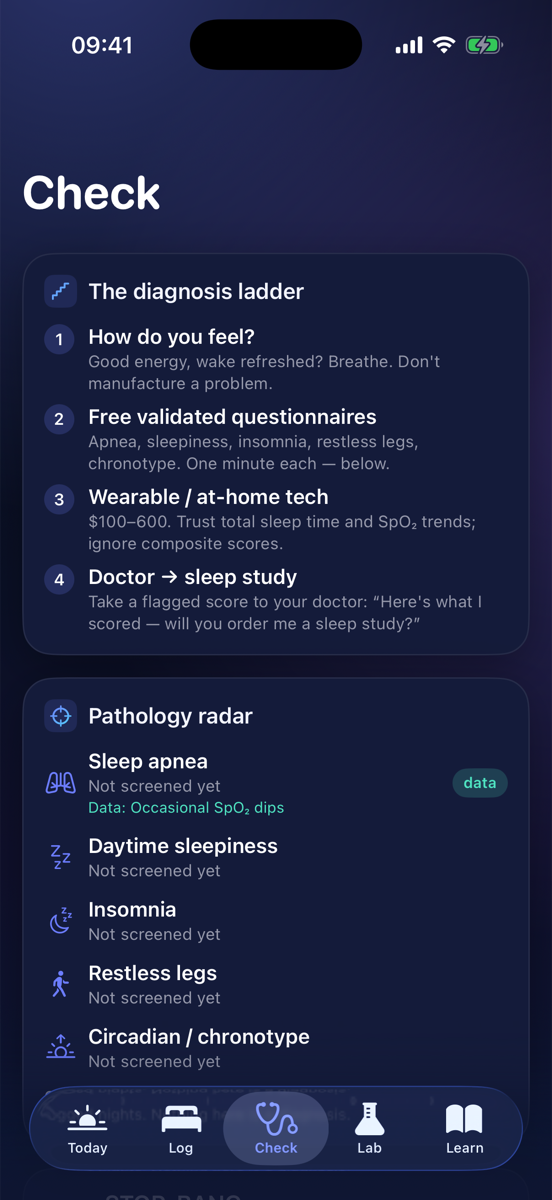
~936 million adults have obstructive sleep apnea; the vast majority are undiagnosed. Regularity of sleep predicts mortality better than duration. Both are one-minute screens in the app.
Built from Dr Andy Galpin's principles: how you feel is the primary metric, trust total sleep time (not sleep scores), change one thing at a time.
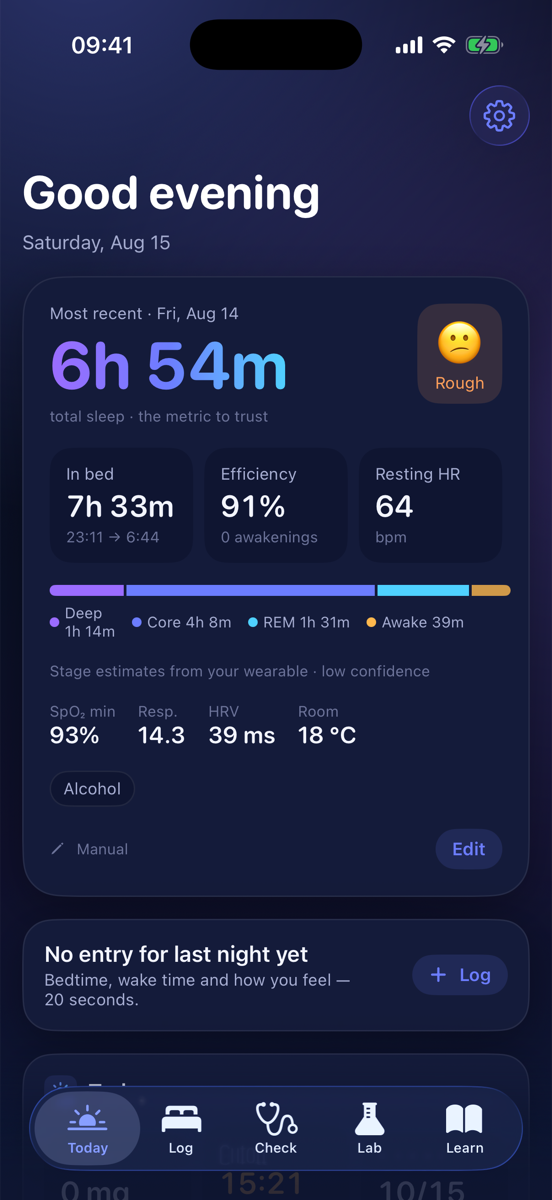
Total sleep, efficiency, resting HR, SpO₂, HRV — from Apple Health or a 20-second manual entry. A 1–5 morning rating leads every day.
Caffeine doses with a personal cutoff, alcohol, meals, screens, morning light, movement (the 5·4·3·2·1 rule), naps, energy, weight & waist, supplements.
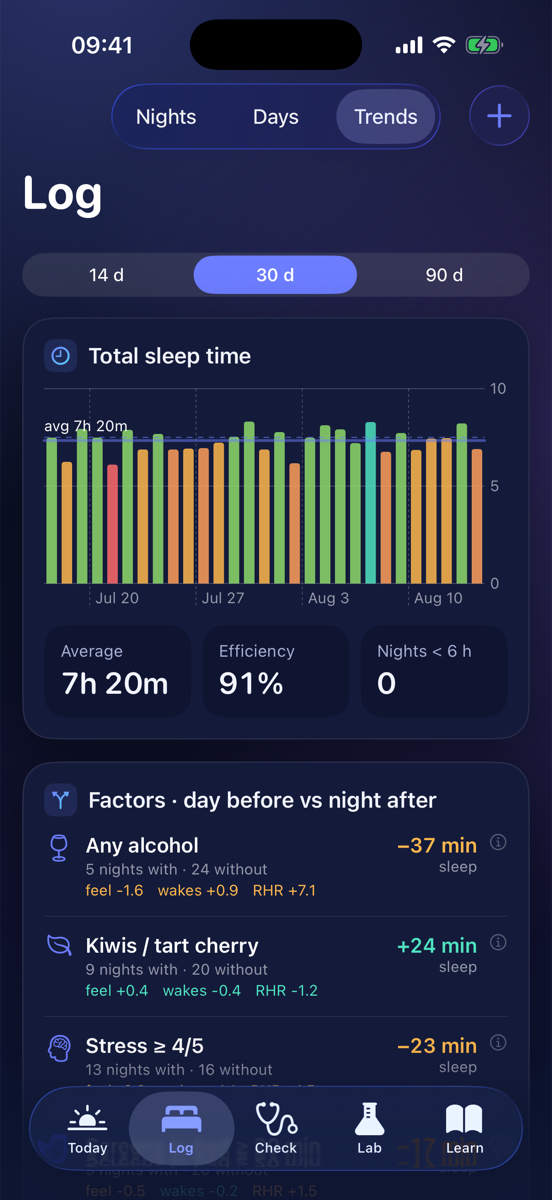
Nights after each behaviour vs without: alcohol −27 min, morning light +16 min… your own data, no guesswork.
STOP-BANG, Epworth, Insomnia Severity Index, restless-legs criteria and chronotype — validated, scored, with a next-step ladder and a doctor script.
One-variable experiments (temperature, kiwis, magnesium, separate sheets…) with baseline vs intervention, effect size and verdict. Plus an environment audit and a bedroom noise meter.
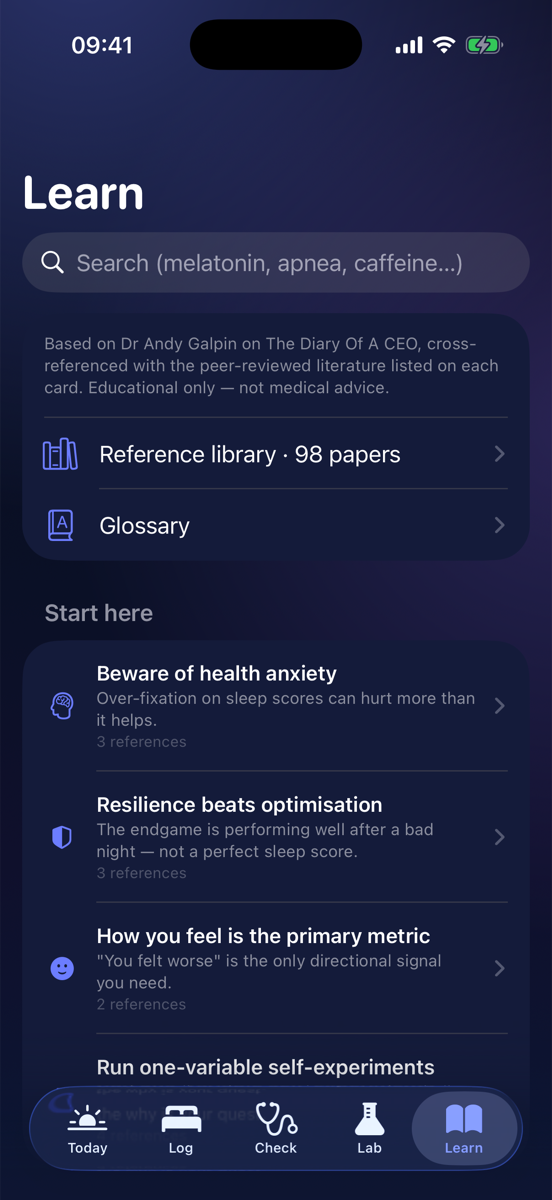
29 cards distilled from the episode and a library of 98 peer-reviewed papers, linked from every claim in the app.
One tap each morning: how do you feel, 1–5. That subjective signal outranks any wearable score.
Tap presets for coffee, meals, screens, workouts, weight. Or let Apple Health fill it in.
Trends pairs each day with the night that follows and your weekly weight change with your weekly sleep.
Turn a promising factor into a Lab experiment. Keep the wins, drop the rest — resilience, not a 12-step routine.
Galpin's fat-loss movement rule, tracked weekly in the app: nutrition drives the deficit, exercise keeps the fat off, sleep decides what you lose.
No. Everything works with a 20-second manual entry each morning. If you connect Apple Health, sleep, heart data, caffeine, weight and steps flow in automatically.
No. SleepShred doesn't count calories for you (though you can log them). It shows how sleep, caffeine, alcohol, meals, screens and training change your sleep — and how your sleep changes your weight.
No. The screening questionnaires are validated instruments, but a score is a screen, not a diagnosis. Take an elevated score to your doctor and ask about a sleep study.
Nowhere. It stays on your iPhone. No account, no analytics, export to CSV any time.
The app was built from Dr Andy Galpin's sleep and fat-loss segment on The Diary Of A CEO, cross-referenced with 98 peer-reviewed papers you can open from inside the app.
Free on the App Store. No account. Your data stays on your iPhone.
Download on the App Store